




DOROTHY - THE
COMPOSER
Apart from Dorothy’s singing expertise
and dynamic stage performances, she later became a prolific composer and
lyricist. Dorothy’s song
writing talents began to develop after her split with Billy Reid –who
had written the majority of her hit songs - in the early 1950’s. In fact
it’s probably no co-incidence that the first Dorothy Squires
compositions emerged in 1953, the year that she had her last Billy Reid
hit with I’m Walking Behind You.
In October of that year Dorothy recorded three of her own
compositions with the Radio Revellers and Geoff Love – these were With
All My Heart, White Wings and Blue Blue
Blue.
Dorothy frequently wrote under pseudonyms such as ‘Pat Westwood’.
‘Emily Jane’ was Dorothy’s
mother’s name and also a writing alias.
Titles under this name include Come Home To My Arms,
which bears resemblance to Anne Shelton’s Lay Down Your Arms – both
were released n the same year, 1956 – and which was also recorded by The
Beverly Sisters. Under
‘D. Lee’ Dorothy wrote With All My Heart in 1953 whilst
seventeen years later she re-recorded the song as the B-side of My Way,
but this time around the song was credited to Dorothy Squires.
My Way spent a total of 23 weeks in the pop charts so With
All My Heart was undoubtedly one of Dorothy’s most
successful compositions. The
opening line of the song, With All My Heart I Love You is inscribed
on the plaque marking Dorothy’s grave in Streatham.
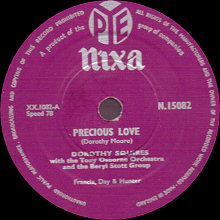
In 1954 Dorothy recorded another of her
own songs, Precious Love, for London Records, featuring Will
Fyffe Jr. as pianist and accompanist.
Three years later she re-recorded the song for Nixa Records (as the
B-side of The Banana Boat Song) and then in the late-Sixties she recorded
Precious Love yet again, this time for the album The Seasons
Of. Another popular
Squires composition of 1957 was Torremolinos, which she
apparently wrote under the pseudonym Juanita Claros when the Spanish
resort was still a relatively small fishing village.
Such was the local popularity of the song that Dorothy was invited
back to Torremolinos as a guest of honour.
She subsequently re-recorded the song in 1968 and included it on
the Dorothy Sings Squires album.
In 1957 Dorothy recorded two more of her
songs, Don’t Search For Love and Sticks And
Stones, both released as a single on the Nixa label.
Around the same time she also recorded another Squires composition,
Our Song, which was coupled with Song Of The Valley and
released on Columbia Records. It
also marked the start of her recording collaborations with musical
director Tony Osborne. The
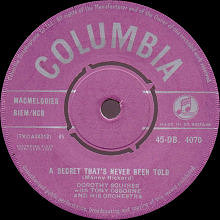
following year A Secret That’s Never Been Told,
co-written with her pianist Ernie Dunstall, was also issued by Columbia.
Interestingly Dorothy even wrote a song
with her then-husband Roger Moore. In
1957 Roger was signed up to play Ivanoe and he starred in 39
episodes, which started being screened on British and American television
in early 1958. Roy Moseley in
his 1985 biography called Roger Moore recalled: “Dorothy would
occasionally join Roger for the shooting, and together they wrote a song
to go with the Ivanhoe series. Roger
wrote the lyrics and Dorothy the music, intending it to be sung by a
baritone over the titles. On
the day of the recording, however, it was discovered that they not have
a male singer suitable and so Dorothy immediately offered her services,
saying: ‘I’ll give it all the balls I’ve got!’ With the
recording finished she stated, ‘My balls touched the ground.’
But despite this remarkable achievement their song was not accepted
and it was instead a song written by someone that Columbia had already
commissioned for the job that was ultimately used.”
By now Dorothy had become a prolific
composer and most of her single releases featured her own songs.
A 1960 single for Decca featured This Place Called Home,
which is registered at the Performing Rights Society under the composer
credit Emily Jane Moore.
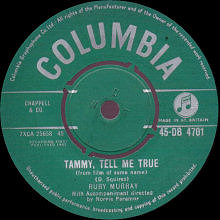
Whilst living in Hollywood, Dorothy was
approached to write the theme tune to Ross Hunter’s Tammy Tell Me
True starring Sandra Dee and John Gavin.
This spawned many versions including those by Sandra Dee herself,
Ruby Murray, Victor Sylvester and his orchestra, Percy Faith and Donna
Douglas. As there were so
many covers of Tammy Tell Me True, chart
placement was lost which was a common occurrence at the time when many
artists would record the same number.
However it is significant and an indication of the song’s
popularity at the time that a reel-to-reel tape came up for auction at
Sotheby’s in 1989, reputedly featuring John Lennon and Paul McCartney
singing along to Tammy Tell Me True while it was played on a radio
in the background. Dorothy
herself recorded the song in October 1966 when she recorded a live album This
Is My Life! In Llanelli, and she reprised the song in November 1972 at
the London Palladium. Subsequently released as a live album Dorothy
Again!
Roger Bolton’s notes for the album Dorothy
Sings Squires recall: “One day she {Dorothy} told me of one of
her biggest thrills: it was when, at 8am one morning, sitting in a corner
of a vast sound stage of the Universal International picture company in
Hollywood, California, she watched an orchestra of 70 musicians under the
direction of Joseph Gerchenson, recording a Percy Faith arrangement,
synchronising to the film track of a song which Dorothy had written,
entitled Tammy Tell Me True, for a picture of the same name – this
starred Sandra Dee and was produced by Ross Hunter, one of Hollywood’s
most prolific talents.”
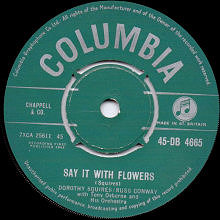
On 24 August 1961 Dorothy entered the
British pop charts with another of her own songs, Say It With
Flowers. Arranged and
conducted by Tony Osborne, and featuring Russ Conway on piano, the
recording spent a total of ten weeks in the Record Retailer chart.
Say It With Flowers was launched at a party hosted by
Dorothy around the swimming pool at her Bexley mansion, and among the
guests there were Cliff Richard, Frank Ifield, Danny Williams, and Russ
Conway. Dorothy also
performed the song on a TV variety show, which was filmed at Billy
Smart’s Circus – she was introduced by Bruce Forsyth who literally led
her into the lion’s den where she performed the song to the bemused
animals! When Say It
With Flowers was featured on BBC TV’s Jukebox Jury programme,
presenter David Jacobs accidentally said: “And that’s the new single
by Rosemary Squires”!
Dorothy re-recorded Say It With
Flowers seven years later, and it became the title track of her
first album for President Records. The
sleeve-notes explain the history of Say It With Flowers: “During
a recording session Dorothy told her recording manager of her idea of
recording an LP only of ‘flowers’ songs and calling it Say It With
Flowers. He asked her if she had the title song written and she said,
‘But of course’, to which he replied ‘Let me hear it’. Dorothy did not have the title song written but on her way
home from the studio that night she had most of the lyric finished, worked
through the night to finish it, then called her recording manager asking
him if he could meet her a publisher’s office.
They met, he heard the song and liked it, so Dorothy said, ‘Well,
when do I make the LP?’ He
replied, ‘Maybe on your next trip over from The States’.
“Two weeks later Dorothy returned
to her home in Westwood Village in Hollywood.
Sadly she put the copy of Say It With Flowers in her piano stool,
saying, ‘Ah well, I thought it was a good idea’.
About a year later Russ Conway and his recording manager Norman
Newell were on a promotion tour of the U.S.A., where they visited Dorothy
at her home. Dorothy, arranging dinner in the kitchen, heard Russ playing
her song Say It With Flowers, and thought ‘That melody sounds
familiar’. Norman Newell
heard it and asked who had written it.
Dorothy said that she had, to which he replied, ‘This song could
be a hit, and you’re going to record it when you get back to England’.
Russ promptly said, ‘And I’m going to be on that record with
you’. The rest is history
… with a Tony Osborne arrangement, Tony conducting, Russ on piano and
Dorothy singing, the record was a big hit and put Dorothy in the Hit
Parade, making her the first British star to follow all the big American
names into London’s famous Talk Of The Town.”
Say It With Flowers has
probably become Dorothy’s most enduring song-writing success.
Apart from her own two studio recordings of the song, it also
featured on several of her live concert recordings.
In addition Russ Conway recorded the song in his own right, and
there have also been other versions by Joe Longthorne (who performed it on
his TV show) and Dorothy’s great friend, Danny La Rue who included it on
his 1978 album, To Mother With Love.
When Dorothy was impersonated on the popular Saturday night show
Stars In Their Eyes in 1998, Say It With Flowers
was the song performed by a Blackpool landlady!
Dorothy recorded many of her own songs
during the Sixties. Whoever,
also arranged and conducted by Tony Osborne, was recorded in May 1962 and
issued as a single by Columbia. It
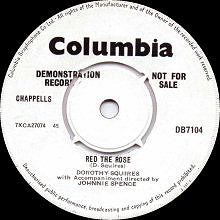
was followed by Are You? (arranged by Johnnie Keating), Once
Upon A Time (accompaniment by Johnnie Spence), I
Won’t Cry Anymore and Red The Rose (Johnnie
Spence), Look Around and Two Strangers Met (conducted
by Geoff Love), and Have I Waited Too Long (co-written with
Ernie Dunstall, arranged and conducted by Mike Leander, and issued on
Decca). On February 18th
1966 Dorothy recorded the dramatic Someone Other Than Me (musical
arranger Johnnie Pearson) and The Call Of Spring,
issued as a single by Columbia Records shortly afterwards. Someone Other Than Me was co-written with actor
Mark Eden (of Alan Bradley/Coronation Street fame) and Ernie Dunstall.
In 1968 Dorothy signed to President
Records, heralding the start of her long-overdue recording comeback.
Her first single for the label coupled two of her own songs, When
There’s Love In Your Heart (co-written with Ernie Dunstall) and
the dramatic Where Can I Go.
The second single featured Point Of No Return, while
the third coupled two more Squires compositions, Your Flowers
Arrived Too Late and Red The Rose.
Her fourth President single, For Once In My Life (which gave
Dorothy her first Top 30 hit in eight years) featured Our Garden
on the B-side. Dorothy’s
first album for the label, Say It With Flowers, featured
several of these titles: Your Flowers Arrived Too Late, Red The Rose
and Our Garden.
Dorothy composed the title song of her
second album The Seasons Of, and it was also used as the
B-side of her hit single Till. The
album also included Point Of No Return, Where Can I Go
and I Won’t Cry Anymore.
In 1970 President Records’ Joy label released Dorothy Sings
Squires, which brought together 12 of her own songs including Look
Around, With All My Heart (which
was covered by The Bachelors back in the 60s, and even released as a
single by them in Switzerland!), The Good Things, Torremolinos,
Precious Love and Play It To The Rules.
There was further tribute to Dorothy’s
composing talents when her musical arranger Nicky Welsh recorded his own
album, From The Pen Of Dorothy Squires To The Baton Of Nick
Welsh. The 12 songs
featured were: For Emily, Tammy Tell Me True, Liza’s
Song, David’s Theme, Megan’s Theme, My Sarah Jane, Say It With
Flowers, Torremolinos, The Seasons Of, Two Strangers Met, Look Around and
Happy To Know.
Throughout the Seventies Dorothy
continued to write new songs. Her
1970 Palladium concert comeback introduced It Can’t Be Done
and I Can Live Again.
Controversially, at her 1973 Theatre Royal, Drury Lane concert
Dorothy re-wrote some of the lyrics to the Dorothy Fields/Cy Coleman song
Nobody Does It Like Me, so that they referred to personal incidents in her
dramatic life. The composers
objected and an album recording of the show had to be withdrawn.
It later reappeared minus Nobody Does It Like Me.
Don’t Ask Me Why,
co-written with Mark Eden, was issued as the B-side of the 1971 President
single Maman and Let Me Take Care Of You was issued as the
flipside of the Mame song If He Walked Into My Life.
In 1972 Bell Records released Dorothy’s recording of If I Could
Go Back, penned by Burt Bacharach and Hal David for the film The Lost
Horizon. Dorothy wrote its
B-side As The Saying Goes with Mark Eden and Ernie Dunstall.
In 1974 Dorothy released a new album Cheese
‘N’ Wine for Pye Records.
It included vocal contributions from Dennis Lotis.
The title song was yet another Squires composition and the album
also included Dorothy’s I Never Thought.
Dorothy’s 1974 single The Impossible Dream, also issued on Pye,
featured a Squires/Dunstall song Eyes Of A Man as the
B-side. Three years later Dorothy released Rain, Rain Go Away
on Decca Records. Produced by
Norman Newell at Abbey Road Studios, the album was originally intended to
tie in with the publication of Dorothy’s autobiography (which ultimately
never saw the light of day). The
album included three Squires songs: We Clowns, Megan
(co-written with Norman Newell) and If I Had A Chance.
We Clowns also featured on the 1980 live album We Clowns
– Live At The Dominion, and was also issued as a single by President
Records.
The last Squires song to be recorded by
Dorothy and released during her lifetime was The Wine
Is There, released as a single on her own Esban Records label in
1984. However, following Dorothy’s death, President Records released the
I Am What I Am CD and it included a previously unreleased song The
Chosen One, co-written by Dorothy with her pianist Kenny Brown,
and which has certainly aroused controversy among her fans with its rather
unconventional lyrics!
Dorothy was also responsible for
co-writing with Mark Eden and Ernie Dunstall the score for a projected
stage musical, Old Rowley, based on the life of King Charles II and Nell
Gwynn. She introduced two
songs from the score, Will There Be A Place and Heart
Of A City, at her 1973 Drury Lane concert, and during the next few
years frequently featured songs from Old Rowley in her stage shows.
Sadly the show was never actually staged, but at her Dominion
Theatre concert in 1979 the first half of the show was devoted to Dorothy
performing all the songs from the show.
For some reason these have never been commercially released,
although the second half of the same show was eventually released as the We
Clowns – Live At The Dominion. For the record, the songs performed
were: Pudding Lane, Old Rowley, Royal Command Performance, Will
There Be A Place?, A Friend Is Someone, Heart Of The City, My Room, Sleep
Sleep My Baby, You Can’t Put A Price On Your Heart, Doth Thou Love Me
Nell?, You Waken Up One Morning, and Old Rowley Medley.
The Performing Rights Society’s
records reveal that Dorothy wrote many songs that were never actually
published. They include Acapulco Mexico, Blue Skies, Bord Na Mona,
Charmeuse, Chez Moi, Clackers, Gaiety High, Guiding Hand, Handle With
Care, Ivanhoe Of England, I Love The Queen, Nice To See You and
Saphic Dream. Some of
the songs are credited to ‘David Lee’. Intriguingly
several of her Fifties composition appear to have been co-written with a
George Moore – the name of Roger Moore’s father – and one song Esther
is credited to Tony Osborne, Roger Moore and Dorothy Squires.
Dorothy’s niece Emily says: “George
Moore was Dorothy – she didn’t write songs with Roger’s father,
which is perhaps the impression given.
I wondered about the pseudonym David Lee.
If it was in the 60s David was the name of Mark Eden’s son -
Dorothy was dating Mark at the time.
The Lee I’m not sure, but her friend Betty’s husband was called
Lee and he was also my father’s friend.
They died within weeks of each other.
I don’t know why she used other names; maybe she thought she
would be taken more seriously with a male name there.
Strange!”
Whatever the reality, nowadays of course
there is nothing unusual about female singers writing their own material,
but Dorothy was brought up in the days of the traditional Tin Pan Alley
when women were usually sidelined as songwriters. Dorothy Squires was
probably one of the first British female singers to write her own songs,
paving the way for other singers like Petula Clark and Jackie Trent.
Many of her compositions are available on various Squires CDs and
yet her undoubted song writing abilities have often been ignored. The evidence is in the music that Dorothy has left behind.
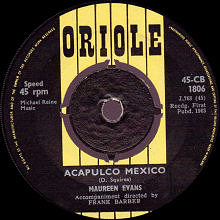
With thanks to Emily Squires and Mark Wallace for their help in providing information for this article. Incidentally Mark Willerton of the Burtey Fen Collection points out that early 60s pop singer Maurren Evans also recorded a Squires song, Acapulco Mexico, released in 1963. Interviewed by Mark for the magazine Best Of British, Maureen told him that her father was delighted when she did the song as he had always been a big Dorothy fan.
© 2004 - 2011 www.dorothysquires.co.uk


