
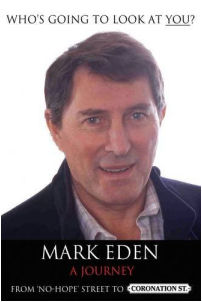
 Actor Mark
Eden, probably most famous for his role as baddie Alan Bradley in
Coronation Street – killed under a Blackpool tram while pursuing love
interest Rita Fairclough – knew Dorothy Squires for a number of years
including co-writing several songs with her. He writes extensively about
Dorothy in his 2010 autobiography Who’s
Going To Look At You?, published by Troubadour
Publishing.
Actor Mark
Eden, probably most famous for his role as baddie Alan Bradley in
Coronation Street – killed under a Blackpool tram while pursuing love
interest Rita Fairclough – knew Dorothy Squires for a number of years
including co-writing several songs with her. He writes extensively about
Dorothy in his 2010 autobiography Who’s
Going To Look At You?, published by Troubadour
Publishing.
“It was
while I was filming Catch Hand (in which his co-star was Anthony Booth) that I first met Dorothy
Squires. She happened to drop by the house of a mutual friend while I was
visiting and before she had left she had invited me to one of her famous
parties at her home in Bexley, Kent. The bash was – as all Dot’s
parties were – a star-studded affair, packed with well-known names from
the music and variety side of show business. I still can’t remember how
she and I ended up in bed that night but we did and a bizarre kind of
relationship began. From the start it was an unlikely liaison. Dot was 18
years older than me and not the kind of woman I normally found attractive.
She was loud and brash, wore chunky, ostentatious jewellery, drove a Ford
Thunderbird, and swore like a Billingsgate porter.
She had been devastated by the break up of her marriage to Roger Moore and was pretty cynical as far as men were concerned, but we seemed to hit it off, in a macabre kind of way. To described our subsequent affair as ‘tempestuous’ would be an understatement. We both had explosive tempers allied to short fuses, and we had constant pyrotechnical rows. But the biggest mistake was going on holiday together.
When I had finished filming Catch Hand, Dot, myself, Ernie Dunstall who was Dorothy’s accompanist, and two of Dorothy’s gay friends, Adrian and Bobby, went to Torremolinos on the Coast del Sol where we rented a large villa. Things started to go wrong almost as soon as we arrived. The main bone of contention being Dot’s penchant for sitting on the beach all day, every day. I have never been a sun worshipper and I can’t swim, so sitting on a crowded beach all day with sun block smeared all over my body, and sand in my crotch, held very little appeal. In fact none at all.
Consequently
while Dot lay prostrate on the beach I would go into Torremolinos where
you could buy the previous day’s English newspaper, find a shady bar and
partake of some tapas and a glass or two of rioja. I was soon to be joined
by Ernie Dunstall who, like me, couldn’t see the point of trailing down
to the beach and spending the entire day in a state of total inertia.
Consequently we decided to hire a car for a week and drive out to
somewhere different every day. On the first day we bought a map and, with
Ernie driving, motored over to Granada and spent an enjoyable day
exploring the city.
On another
occasion we went to Toledo. Some days we would just drive and if we saw
something that looked interesting we would stop and explore it.
Another day we went to Malaga Airport and took the short-hop plane
over to Casablanca. Even at night there was disagreement. Dot, Adrian and
Bobby usually wanted to go to a club, while Ernie and I favoured a quiet
restaurant where you could actually hear what everyone was saying. The
sense of relief when we landed at Heathrow was palpable. Each of us, I’m
sure, making a mental note never to go on holiday with certain people ever
again.
Later, Eden opened in a Tennessee Williams play in Croydon, prior to its transfer to the Savoy Theatre in London’s West End. “For the past four weeks I had been consolidating my friendship with the fair Patricia (actress Patricia Shakesby) and had decided to ask her out for the first time to the after-show party at the Savoy Hotel. To this end I told Dot that only cast members had been invited to the party afterwards. Her immediate reaction was, ‘If I can’t come to the party, I’m not coming to the first night’, which was fine by me. During the first interval of the play the stage door keeper brought me up a note. It was from Dot and went something like this: ‘Have arranged our own party at Joe Allen’s (restaurant) after the show. I will await your arrival’. I ignored it. The first night was a triumph. A packed house gave us a rapturous reception, none more so than Tennessee Williams who leaped from his seat in the front row roaring his approval.
Eden’s
relationship with Patricia flourished. “The big problem now was how
to tell Dot. Ours had never been the greatest love story ever told, but I
felt I ought to tell her it was over. Dot reacted to the bad news the way
she always reacted to bad news. She went berserk. I tried to explain the
situation to her over the phone but I couldn’t get a word in edgeways,
sideways, vertically or horizontally. For the next two weeks my phone rang
incessantly, and I was forced to take it off the hook at night to get some
sleep. Eventually things began to cool down a little. The constant phone
calls stopped, and Dorothy seemed to adopt a more conciliatory attitude
when I talked to her.
When she
rang me late one night from a recording studio in south London where she
had just finished recording an album, and invited me over for a
celebratory drink for old times’ sake, I thought, ‘Why not?’ After a
pleasant chat and a couple of glasses of champagne, Dot offered to drop me
off my flat. Alarm bells should have been ringing right then but, trusting
soul that I am, they didn’t. As soon as the car began to move Dot locked
all the doors and said, ‘Right, you bastard. Now I’m taking you for a
ride,’ and so saying she put her foot on the accelerator.
Now the Ford
Thunderbird is a very powerful car and went from nought to 80 in about ten
seconds flat. Fortunately it was around two in the morning and there was
very little traffic around, so we scorched a fiery trail across south
London, jumping red lights and rounding corners on two wheels. I tried
reasoning with her but Dot wasn’t listening as she sat grim faced and
silent, behind the steering wheel. The really frightening thing was that
Dot wasn’t a very good driver at the best of times, and this was not the
best of times. I kept hoping that a police car would get on our tail and
bring our roller-coast ride to an end. But, as we well know, there’s
never a policeman around when you really need one, and we careered wildly
through New Cross untroubled by the boys in blue.
As we left the Metropolitan Police area and entered into Kent Constabulary country, it seemed even more unlikely to me that we would be brought to a halt, except for the intervention of a brick wall, or a tree. Down winding roads we skidded, Monaco Rally style, and suddenly the car screeched to a whiplash-inducing halt. ‘This is where you get off,’ Dot said grimly. I got out and Dot drove away, leaving me in the middle of nowhere. I had to talk about half a mile before I spotted a telephone box, from where I called a taxi to take me home. To paraphrase Congreve: ‘Heaven has no rage like love to hatred turned. Nor Hell no fury like Dot Squires scorned.
During the time we were together Dot and I, along with Ernie Dunstall, write five pop songs – two of which were recorded by Dot and three by The Bachelors. We also collaborated in writing a musical about Charles II and Nell Gwynne, entitled Old Rowley. It us about six months to write and when it was finished Dot hired a recording studio and with me narrating, Ernie on a synthesiser, Dot singing all Nell Gwynne’s songs, and the Mike Sammes' Singers doing the others, we put it all on disc.
Sadly, in
spite of Dot’s Herculean efforts to ‘sell’ it (somebody once said
that if Dot Squires wants to sell you something she doesn’t knock on
your door – she kicks it in!) we couldn’t find any backers. And Old
Rowley was never produced. The sting of rejection was felt far more deeply
by Dot than by Ernie or me. It had been her conception, her baby, and
nobody wanted it. Dot never gave up on Old Rowley. Long after Ernie and I
had moved on, she took every opportunity she could to plug it – but to
no all avail.
One last
story about Dot Squires. It was Christmas time and Ken Parry was playing
Mother Goose at Palmers Green in north London, and Dot decided to go and
see it. She arrived, having had a drink or two en route, wearing a
full-length mink coat and, with her entourage trailing behind her, settled
noisily in the front row.
Now there is a tradition in pantomime that if someone you know is in the audience you somehow contrive to mention their name. As the curtain rose on the second act Kenny was sitting centre stage shelling peas. ‘Dear me,’ he said, ‘nobody loves me, nobody loves me. Thank goodness I’ll always be welcome at Dorothy Squires’ house.’ From the front row of the stalls, Dot was heard to say loudly, ‘Not after this fucking performance you won’t’. Their friendship was never quite the same after that.
To be fair
to Dot – she adored my son David, often having him to stay weekends at
her house in Bexley. When he was 11 years old she took him with her on a
short tour, bringing him onstage every night to sing ‘You’re my best
beau,’ from the musical Mame, in a duet with her which invariably
brought the house down. Dorothy Squires died in 1998 at the age of 83,
homeless and penniless. It was a tragic end to what had been a long –
and at one time – hugely successful career. When I heard of Dot’s
passing, I phoned Ernie Dunstall (Dot’s arranger and pianist) and he
gave me the date, the time and place of her burial.
I wrote it all down and on the appointed day David and I took a
mini-cab to a cemetery in Streatham, SW London, arriving about 15 minutes
before the cortege was expected. After hanging about for half an hour we
began to suspect that something was amiss, made some enquiries – and
realised we had come to the wrong cemetery, which meant we had missed
Dorothy’s funeral, which had been at Streatham Vale Cemetery!
Over a drink in a nearby pub I said to David, ‘How could I have made such a stupid mistake?’ David shrugged and said, ‘Dot didn’t want us there’. I read recently that Welsh Heritage were going to put up a blue plaque on the council house in Dafen, Carmarthenshire, where Dot lived as a child, paid for (by now) Sir Roger Moore.”
The late
Diana Dors had known Dorothy for over thirty years at the time of her
death in 1984 and Dorothy was in fact one of the last people to visit
Diana, just a couple of days
before Diana’s tragic and premature death in hospital. Diana wrote
briefly about Dorothy in her 1979 book Behind
Closed Doors, published by
A Star Book, the paperback division of W.H.
Allen &Co.
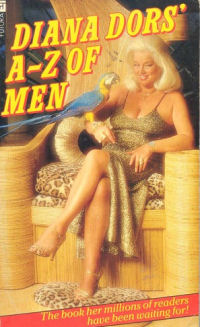 Diana
wrote in her “A-Z of life” memoir, under the section G for Ghosts:
Diana
wrote in her “A-Z of life” memoir, under the section G for Ghosts:
“After
all this interest in the supernatural, I went back to Hollywood again, and
introduced the Ouija board to a number of people over there, among them
singer Dorothy Squires who was then married to Roger Moore. I had known
them both for ten years, having first met Dot in Blackpool with my late
husband Dennis Hamilton, and he and Roger had also been close friends
during his lifetime. Dot was a little dumbfounded at first when she and I
sat together trying to contact the spirits, as for fifteen minutes nothing
happened at all. ‘What is it supposed to do?’ she asked. ‘Just hold
on, Dot,’ I replied. When it eventually gets warmed up and we’ve
contacted somebody you will be astounded. Maybe the atmosphere of
Hollywood is not as good as my old farm in England.’
After
waiting a little longer, the pointer began to move and to our surprise we
made contact with none other than Dennis himself. Dot was amazed, and
having asked a number of questions which he appeared to answer correctly,
as to where she had met him, and so on, she announced excitedly to Roger,
who would having nothing to do with it, ‘Here Roger. We’ve got Dennis
Hamilton on this thing’. Roger looked sceptical and scoffed, ‘Rubbish!
Tell you what, if it really is Hamilton ask him about the pound bet we had
together, he’ll know what I mean.’
 ‘What
bet was that?’ demanded Dot. ‘Just something that happened once,’ he
said. ‘Go on, ask him’ and he smirked disbelievingly. Dot and I did as
he ordered, not knowing what he was talking about, and to our utter
astonishment a story unfolded about an occasion when Dennis and Roger had
climbed in through the window of television producer Dennis Vance’s
house in Windsor, the breaking of glass, and a monetary bet of a pound
which had been involved for some reason. Roger, who up to that moment had
been sneering about the merits of my Ouija board, went deathly white in
colour for the story was absolutely true. Since that day I have also
checked with Dennis Vance himself,
together with his son Patrick, who was there at the time, and it is
completely accurate!”
‘What
bet was that?’ demanded Dot. ‘Just something that happened once,’ he
said. ‘Go on, ask him’ and he smirked disbelievingly. Dot and I did as
he ordered, not knowing what he was talking about, and to our utter
astonishment a story unfolded about an occasion when Dennis and Roger had
climbed in through the window of television producer Dennis Vance’s
house in Windsor, the breaking of glass, and a monetary bet of a pound
which had been involved for some reason. Roger, who up to that moment had
been sneering about the merits of my Ouija board, went deathly white in
colour for the story was absolutely true. Since that day I have also
checked with Dennis Vance himself,
together with his son Patrick, who was there at the time, and it is
completely accurate!”
Diana also mentioned Dorothy in her 1978 paperback For Adults Only, also published by A Star Book. Under the heading T is For Telephone, she wrote:
“Singer
Dorothy Squires is a person who does not like to be hoaxed. I once conducted a whole conversation with her, pretending to
be a newspaper reporter and wound up asking a very impertinent question as
to what she was going to do for sex when her husband Roger was away on
location, Dot was not amused, hung up, and did not speak to me again for
as long while. When she did, it was to ask in quite a hurt tone, ‘Who do
you always make fun of me, Di?’”.
The
late
Leslie
Crowther’s
1994
autobiography
The
Bonus
Of
Laughter,
published
by
Hodder
&
Stoughton,
mentions
Dorothy.
Leslie
wrote:
That
autumn
the
hugely
popular
singer
Dorothy
Squires
was
holding
auditions
for
the
double
part
of
Alderman
Fitzwarren/Sultan
of
Morocco
in
Dick
Whittington
&
His
Cat,
which
was
due
to
open
at
the
New
Cross
Empire
on
22
December
1951.
I
went
along
and
got
the
part.
The
pantomime
was
hugely
successful
and
Dorothy’s
personality
endeared
her
to
the
audiences.
At the time she was having a ding-dong with Roger Moore. I must say I was impressed whenever he came to the stage door. He was a star in the J. Arthur Rank chain of featured artists - and, of course, extremely handsome. Dick Whittington unfortunately lasted for only a month and then, like Christmas, we closed.
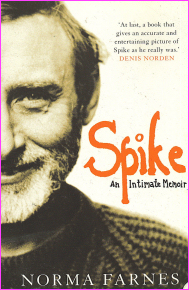 Norma
Farnes
was
Spike
Milligan’s
manager
for
36
years.
Her
book
Spike:
An
Intimate
Memoir
was
published
by
Fourth
Estate
in
2003,and
mentions
Dorothy.
Norma
Farnes
was
Spike
Milligan’s
manager
for
36
years.
Her
book
Spike:
An
Intimate
Memoir
was
published
by
Fourth
Estate
in
2003,and
mentions
Dorothy.
…. Above all, Dad (Norma’s father) idolised a great ballad singer, fiery Dorothy Squires. After meeting in the Middlesborough Empire they became friends and he looked out for her, not that she needed any help because she could be as tough as a bar room brawler. Whenever she was within travelling distance of Thornaby, Dad would be in the audience and through all her tempestuous affairs he was the one who listened quietly to talk of her latest love, and the inevitable parting which had given so much pain – temporarily at least, for there was always a new man in her life (this was before Dorothy married Roger Moore).
Dad knew that Dorothy could be a demanding monster with the hide of a politician and, like many of that breed, she was often ruthless and unforgiving. But because of her talent he excused her frailties.
My parents often went backstage to see Dorothy after the curtain came down and, one evening when I was about 12, they took me along with them. I was utterly bewitched by this glamorous singer.
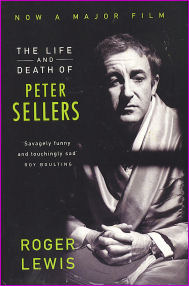 Dorothy
is
mentioned
in
Roger
Lewis’
biography
of
the
late
Peter
Sellers,
The
Life
And
Death
Of
Peter
Sellers,
published
by
Arrow
Books
Dorothy
is
mentioned
in
Roger
Lewis’
biography
of
the
late
Peter
Sellers,
The
Life
And
Death
Of
Peter
Sellers,
published
by
Arrow
Books
Lewis
writes:
“Also
relevant
to
the
psychodrama
is
his
{Sellers)
fondness
for
younger
women
as
he
got
older
–
women
who
were
his
children’s
contemporaries.
He
once
said
to
Dorothy
Squires,
‘Dot,
love,
I
can’t
help
it,’
and
she
said,
‘You
are
your
own
worst
enemy,
going
around
with
all
these
starlets,’
–
‘But
I
just
can’t
help
it’.
Referring to one of Seller’s early performances in variety, Lewis adds:
“Sellers was back to being Sellers when he went, next, to Peterborough, as the bottom of the bill comic in a show starring Dorothy Squires.
Dorothy, in sunglasses and white rabbit fur, was then starting out as a songbird with Billy Reid’s Accordion Band. If Ethel Merman and Edith Piaf had mated, Dot might have been the result. She was never any stranger to controversy (she tended to biff policemen if they attempted to breathalyse her) and when her under-insured house caught fire, she quipped: ’Next time I’ll live near water.’ She moved to a riverside property outside Maidenhead and was flooded. Her ballads thus had to do with women who find fate an unpredictable jade; who are neglected and degraded – and her torchy numbers might easily be applied too, to the trampish life of any performer. ‘Sticks and stones is the name of the game/For the clowns who choose to entertain.’
All
apt
for
Sellers,
whose
George
Formby
impressions
and
uke
playing
were
boring
the
audience
in
Peterborough
to
distraction.
‘To
stand
on
a
stage
and
be
the
centre
of
such
hostility
is
a
frightening
experience.
I
was
literally
shaking
when
I
came
off,’
he
remembered.
‘During
the
interval
between
houses
the
manager
came
to
the
dressing
room
I
was
sharing
with
six
others,
and
handed
me
a
cheque
for
£12.
‘You’re
no
good
here,
Sellers
boy.
Here’s
your
money.
There’s
no
need
for
you
to
appear
again.’
I
sat
there
miserably,
determined
not
to
give
up,
but
not
knowing
what
to
do.’
Miss
Squires,
realising
that
her
own
vampish
act
was
affecting
the
audience’s
mood,
unpreparing
people
for
Seller’s
whimsicalities,
interceded
on
the
young
man’s
behalf.
‘I
hear
you’ve
fired
the
comic,’
she
said
to
the
manager.
‘I’d
like
you
to
keep
him
on.
You
know
Monday’s
always
a
bad
house.’
‘Well,’
came
the
grudging
assent.
‘I
think
he
must
be
the
worst
comic
in
the
business.’
Disconsolately,
the
non-comic
went
back
to
the
drums,
‘as
I
had
quite
an
aptitude
for
that,’
and
he
received
£12.10s
for
a
week
at
the
Aldershot
Hippodrome,
commencing
February
9th
1948.
‘It’s
a
story
of
total
and
absolute
disaster,’
Graham
Stark
has
said
of
Sellers’
appearance
there,
‘it
unfailingly
reduced
me
to
tears
of
laughter.’
Lionel Blair
In his 1985 autobiography Stagestruck (Weidenfeld & Nicholson) Lionel Blair noted:
I
booked into a hotel in Hollywood and thought it might be worth trying to
contact Roger Moore as he was living there by then.
I’d stupidly left my address book in London, so I rang the
biggest agency in Hollywood and asked if they knew where he was.
They very helpfully put me on to his agency, who said they
couldn’t give out numbers, but they would pass on a message to him.
I think within five minutes of that call Roger was on to me,
insisting that I pack my bags right away and he would come over and take
me to his house in Westbury. There
he introduced me to his wife, Dorothy Squires, and they were both
immensely kind and entertained me royally.
There were lots of rumours in Hollywood that things were strained
between them, but while I was with them there was no outward sign of it.
But that’s Hollywood, people are on show even when they’re at
home …
Beryl Reid
In her 1984
autobiography So Much Love, (Hutchinson) Beryl wrote:
One
of the first weeks I ever did in variety was at the Argyll, Birkenhead.
As I approached the theatre I saw the word REID written in great
big letters and thought, really, for £5 a week they’re overdoing the
billing a bit, then when I got nearer I saw that it was Billy Reid and his
Accordion Band, with Dorothy Squires as the singer, and I was tiny, tiny
– down in the wines and spirits bit.
There were the most wonderful rows with broken chairs and flying
records from Billy Reid and Dorothy Squires, something I’ve never
witnessed before in my life. I was still quite sheltered and my brother drove me back
every night.
Barbara Cartland
The late
Dame Barbara Cartland paid tribute to Dorothy in her 1982 Book Of
Celebrities (Quartet)
I had heard vaguely of her turbulent quarrels, her unhappiness when Roger Moore left her, her numerous law-cases and many other things. I knew she had enormous voice because, like Harry Secombe and Shirley Bassey, she came from Wales.
But nothing prepared me for a very small, pretty person with a little-girl hair-do and exquisite feet.
Dorothy Squires picked me up at the studios of L.B.C. after I just finished making an album with the Royal Philharmonic Orchestra and I had the same wonderful famous producer, Norman Newell, as she had.
I asked her to lunch, she came and cried all through my recording I’ll See You Again because it reminded her of Roger. She insisted, although I tried to refuse, that I should go to her concert.
Every year Dorothy takes a theatre to sing to her fans, she does not advertise, but by instinct they all turn up to hear her. This year she had taken the Palladium on Guy Fawkes Night, the 5th of November, which everyone thought was mad. ‘The worst night to sell a seat in any theatre,’ they told me.
 The
Palladium was packed from floor to ceiling, there wasn’t a square inch
to put a mouse! Dorothy took
the roof off! Where she keeps
that voice I couldn’t imagine! Then
she told the audience how she met me, how much she loved my Album Of Love
Songs, and she made them all sing If You Were The Only Girl In The World
to me as I sat in the Royal Box.
The
Palladium was packed from floor to ceiling, there wasn’t a square inch
to put a mouse! Dorothy took
the roof off! Where she keeps
that voice I couldn’t imagine! Then
she told the audience how she met me, how much she loved my Album Of Love
Songs, and she made them all sing If You Were The Only Girl In The World
to me as I sat in the Royal Box.
She followed it with I’ll See You Again with tears in her eyes and then told everyone to buy my album. It was an unbelievable tribute from a professional to an amateur, from one woman to another! I think only a Celt could have been so generous in thought, word and deed!
On her Christmas card to me she wrote: ‘No Queen has and ever will look as beautiful as you did in the Royal Box of the London Palladium. Love Dorothy’
Her
heart is as big as her voice.
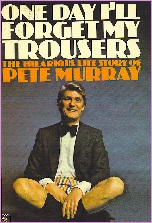 Pete
Murray
Pete
Murray
In
his hilarious 1975 autobiography One Day I’ll Forget My Trousers (Everest)
Pete Murray wrote:
At
the end of 1971 Dorothy Squires came to me and said: ‘I’m doing
another show at the Palladium and I’d like you to compere it.’
‘If
you don’t mind, I’d rather not, Dorothy,’ I said. ‘It’s not
really my scene’. I had
visions of schizophrenia about whether to be funny at the Palladium or
not.
‘You’re
going to do the bloody thing, you see?’ said Dorothy, for whom the
answer ‘No’ does not exist. So
I did it.
After
introducing the four acts in the first half of the show, I sat in my
dressing room during the interval waiting for the second half.
Then it began to dawn on me that it was becoming rather a long
interval. I went along to
Dorothy’s dressing room to find out what was happening, and there I was
confronted by, Dorothy Squires in negligee.
‘What’s
the matter, Dorothy?’ I asked, attempting gentleman that I am, to keep
looking her straight in the eyes.
'The
bloody dress hasn’t arrived,’ she fumed.
‘It’ll be another five minutes at least.’
‘Don’t
worry,’ I said. ‘I’ll go out and explain what’s happened. Are you sure it will be only five minutes?’
She
nodded and I went onstage. I
told a few stories, and glanced into the wings.
Nothing was happening. I
told a few more stories. Still
nothing. By now I was
starting to get desperate. What’s
more I was rapidly running out of clean stories.
Then the dream happened.
A
woman from the audience shouted out: ‘I know you.’
‘Thank
you very much,’ I said.
‘Yes,’
she said. ‘You’ve been up to my flat, and I made you a nut cutlet.’
It
was a gift from heaven. The
audience went into hysterics and she gave me at least ten more minutes of
material to last until Dorothy finally came on.
I don’t know who that woman was, nor, I regret to say, do I
recall her nut cutlet, but if she reads this … Thank you Madam.
At
the end of the show I stayed to give Dorothy her bouquet of flowers. The audience loved her, and she burst into tears, and put her
head on my shoulder.
Now
there are quite a number of gay people among Dorothy’s devoted
following, and at the party afterwards one beautiful young man came up to
me. ‘You know, I never liked you,’ he lisped. ‘Never liked you.
Thought you were a hard man, a hard, shrewd man.
But the way you picked up those flowers for Dorothy, well, it was a
sight for sore eyes. I
thought to myself, here is this hard man … you’re all heart, Pete,
you’re all heart. And then
when you put your arm around her to comfort her … Oh my God, I’d like
to put central heating into your Open House any time you like.’
I
did not avail myself of this offer.
 Bruce Forsyth
Bruce
Forsyth, in his 2001 autobiography, Bruce – The Autobiography,
published by Sidgwick & Jackson, pays a warm tribute to Dorothy.
Bruce writes:
One of the Talk of the Town (nightclub) regulars was a favourite singer of mine, Dorothy Squires. In her day Dorothy was, in many people’s views, and not least mine, one of show business’s all-time ‘greats’. She had a truly force-to-be-reckoned with voice and a dynamic way of putting songs across. I always judge a singer by whether they make you listen to the words and, when Dorothy sang, every word penetrated your ear and hung around in there. She really was a great performer. I didn’t know her very well, but I did work with her on a couple of variety bills. The first time was quite early on in my career when I was a second-spot and she was an excellent top-of-the-bill. Dorothy was happy, a bundle of fun in those days. She was married to the actor Roger Moore, a very handsome guy who was the star of the TV series The Saint, and later took over from Sean Connery as James Bond’s 007. Her language could be a bit strong at times, but she was just great with all the lads, and we shared lots of laughs with her. It was quite common then to be on a bill with stars who were not that friendly, but Dorothy always found time to say ‘hallo’, chat, and be amenable to the theatre staff.
The time I remember her best, though, was when she was booked for a season at The Talk of the Town. Her marriage to Roger, whom she loved so much, had just broken up. I went along with Billy Marsh to the opening night. Because Dorothy was still so deeply affected by the break-up, she had included in her repertoire that evening every sad heartbreaking song ever written – The Man Who Got Away …., Can’t Help Loving That Man Of Mine, It Had To Be You, and so on. She sang these heart-rending tear jerkers for an hour or more, before finishing, as she always did, with a great big belter of a number about not being able to face life without her man, which went on, and on, and on. Oh dear! My heart bled for her. And although everybody by now was feeling a trifle depressed themselves, they all responded by standing up and giving her a great ovation. Billy and I were sitting next to Evelyn Taylor, a wonderful character and one of the best woman agents in British show business. A petite lady, Evie looked up at me and said: ‘Oh Bruce, wasn’t she absolutely marvellous. This is what ******* showbusiness is all about. Billy and I had to look away because we couldn’t help grinning at her choice of word; or believe that she thought show business was all about people going on to give such free vent to their personal emotions! That, we thought, was quite something for such an experienced agent. But I loved dear Dorothy a lot, thought she was wonderful. And I, for one, never minded her wearing her heart on her sleeve.”
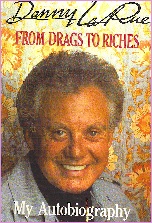 Danny La Rue
Danny La Rue knew Dorothy for well over forty years and regularly impersonated her in his lavish stage shows. He paid tribute to Dorothy at the unveiling of the plaque to songwriter Billy Reid, which took place in Southampton in September 2002. In his 1987 autobiography From Drags To Riches, published by Viking, Danny noted:
I do so much admire the women I characterize. I pay tribute to them in my own way. In our business, a woman has to be at least twice as good as man to succeed. It is awfully unfair.
When I first started out in the business I found my own inspiration in such artistes as Gracie Fields and Dorothy Squires, no-nonsense performers who just got up on stage and did it without fuss, and they did it well. Although I didn’t model myself on anybody, there were some very good comediennes around at the time, like Revnell and West, and Suzette Tarri, and my performance developed through watching, taking it all in, and learning. Dorothy Squires has been a constant source of delight and inspiration. When I do Dot Squires on stage, I nudge the audience in the ribs. She loves it.
 Norman Wisdom
Norman
briefly refers to Dorothy and Billy Reid in his 2002 book My Turn,
published by Century.
My first actual TV special in the title role was called Wit And Wisdom. It was a 45-minute variety show that went out from ‘Ally Pally’ at 3.00pm on 18 October 1948, and my guests were Dorothy Squires and Billy Reid, with the resident BBC baton-swinger Eric Robinson and orchestra. We repeated it again two nights later at prime time viewing – 8.30pm. You could probably count the watching viewers in tens rather than thousands, but it certainly set the adrenalin running.
 Helen Shapiro
Helen
Shapiro mentioned Dorothy several times in her 1993 autobiography Walking
Back To Happiness, published by HarperCollins.
Recalling her early days as a 14-year-old chart-topping artist,
Helen wrote:
When I did a week at the Chester Royalty Theatre during the summer holidays I topped a variety bill of magicians, comedians, all kind of acts … I wasn’t on my own but I was lonely. It wasn’t how I imagined show business would be. Dorothy Squires was the brightest spot of the week. I remember her coming to see me and explaining how essential it was to pay special attention to make-up on stage because of all the strong lights. …
I got to meet Dorothy Squires again. She must have had her opening night when we celebrated my birthday at the Talk of the Town because there was certainly a star-studded audience. A bunch of us went round to her dressing room to congratulate her afterwards. I’d never seen anything like it. She had a big cocktail cabinet and was handing drinks to everybody. The two of us posed for photos with her giving me a birthday kiss. She was very nice to me. All the established stars were. I was just a kid….
There was another link with those early days when I received an award {in 1991} from the British Academy of Songwriters, Composers and Authors, along with Shirley Bassey, Alan Freeman, Gerry Marsden, Marty Wilde, Dorothy Squires and several others, which was a great honour …
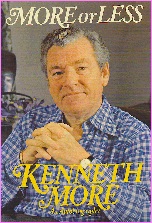 Kenneth More
The late
respected film actor Kenneth More had a legal skirmish with Dorothy back
in the late 60s. The event was recalled in his 1978 autobiography More
Or Less, published by Hodder And Stoughton.
Kenneth wrote:
Nineteen-sixty-nine was also the year of an unfortunate lawsuit involving Dorothy Squires. I had been asked to be a commentator at the British Film Academy Awards reception which was to be held in the Hilton Hotel in London. They were making a TV programme of this, and my job was to introduce each guest as they arrived, and say a few words about them.
The evening started off as a great success. I stood at the top of a long staircase from the entrance hall and made my spiel … ‘Now here we have Sir Ralph Richardson … and Sir John Gielgud .. and here comes my old friend Roger Moore and his charming wife Luisa …’
And they all passed by on their way to the reception…..
The evening seemed to pass off splendidly. But within a few weeks I received a letter from a firm of solicitors claiming that I had slandered their client, Miss Dorothy Squires, who was in fact Mrs. Roger Moore, in that I had called another woman his wife. At that time Louisa was not married to Roger, although she had borne him two children. I knew that he had been married to Dorothy Squires, but so far as the world was concerned, he was living with Luisa as his wife.
I wrote a letter of apology, but the solicitors replied that this was not sufficient. Dorothy Squires was going to sue me in the High Court. I therefore consulted my old friend, Michael Havers (the future Attorney General). ‘Will you handle the case?’ I asked him. ‘With pleasure’.
When the case came to court, the judge took time off to see a re-run of the TV film at the Hilton. ‘Now when you go into the witness box tomorrow, don’t start giving a histrionic performance, Kenny. I know you’re an actor, but don’t begin spouting a lot of bloody nonsense. Just answer the questions I put to you. Nothing less, but nothing more.’
… I gave what I thought was a magnificent oration. I admitted that I might have been wrong. Dorothy had a point. And then I looked down and saw Michael Havers literally cringing under his wig. When I came out of the box he said, ‘I told you to say nothing except answer my questions. Kenny I am never, never going to defend you again.’
Anyway, we won. The jury took thirty minutes to decide what I had said was not defamatory and Dorothy Squires was faced with a bill of £3,000 or more, for costs. She accepted this situation stoically, and like the trouper she is.
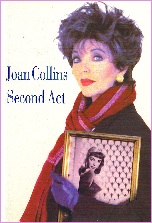 Joan Collins
Joan Collins relates an amusing story about Dorothy in her autobiography Second Act, published by Boxtree in 1996. Recalling the first time she met her great friend Roger Moore, Joan writes:
One day I came home from school to our Great Portland Street flat, and heard a woman’s high-pitched laugh, then the same voice yelling angrily at my father. I slipped in through the front door and saw, sitting in the hall, one of the most handsome men I’d ever seen in my life. I blushed, practically swooning, as he stood up, smiled his devastating smile at me, and said, ‘How do you do? You must be Joan. I’m Roger Moore.’
I stuttered a few banalities, my ears tuned in to the cacophony of screeching coming from the living room, where Daddy seemed to be locked in mortal combat with a demented parakeet. Roger noticed my expression, smiled and said, ‘Oh, don’t take any notice of that. It’s just my girlfriend discussing a deal with your father’.
‘Your girlfriend?’ I said. He seemed awfully boyish and looked about twenty three. ‘Who is she?’ I asked boldly.
‘Dorothy Squires.’ He smiled again.
‘Oh yes, the singer, yes I’ve heard of her.’
Suddenly the lady in question came bursting out of the living room followed by my father. They were shrieking at each other at the tops of their lungs. My father could bellow with the best, but Dorothy was in a league of her own. Her voice was so shrill that it could shatter glass. She was wearing what was then called ‘the lot’ – peroxide hair piled high, a ton of blue eye-shadow, cyclamen lipstick, several rings, bracelets, dangling ear-rings, a necklace, a low-cut floral frock, ankle-strap shoes and a mink stole over her arm. Dorothy Squires was about ten years older than Roger Moore, but in those days any woman over thirty was considered over the hill – my father had told me that enough times.
“Then, to my surprise, Dorothy’s tirade turned to howls of laughter and she turned to my father, kissed him full on the lips, which made me blush, and announced: ‘All right, darling, you win. I’ll take the bloody date.’ With that she took her handsome husband’s arm and teetered out of the front door.
‘What was all that about Daddy,’ I asked.
‘Oh, it’s just Dorothy being difficult as usual,’ he snorted. ‘I’ve just signed her for a tour. She wants this, she wants that, and then she wants the other. She always asks for the moon.’
‘Why does she need the moon when she’s got Roger Moore?’ I asked.
‘He’s got some promise,’ said Daddy. ‘Maybe I’ll sign him too. He could be good for films.’
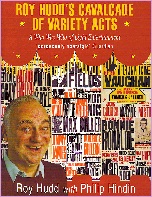 Roy Hudd
Roy Hudd’s
Cavalcade Of Variety Acts (Robson Books) includes a warm
tribute to Dorothy.
You always have to be careful writing about the ‘immortal’ Dot – in case you get sued! – but I have only good things to say about this real trooper and superlative show woman. She began as the vocalist with a local dance band, coming to London, now as Dorothy Squires, at eighteen. She became the singer with Charlie Kunz. It was a one-night gig with Billy Reid’s Accordion Band that changed her life. Billy could write songs and Dot could sing ‘em. Throughout the Forties and early Fifties the pair of them topped Variety bills everywhere and sold thousands of records. Everything was lovely until she met an unknown actor, Roger Moore; she parted from Billy and she and Roger married in 1953. Far be it for me to comment but many people tell me Dorothy neglected her own career to promote Roger. She succeeded; he became a film star and they parted in 1961.
The indestructible Dot battled on. She consistently made the charts, all without the help of TV exposure or airplay on radio. She didn’t know why the powers that be were ignoring her so, in 1970, in a fit of pique, she hired the London Palladium to show them all. Her Sunday night concert was a sensation. She packed the place and all those who had dismissed her as a has-been had to eat their words. Her version of My Way made the charts and her concerts all over the British Isles were triumphs. Her annual London concerts became a regular event and her audiences, those who remembered, those who saw her as our own tragic Judy Garland figure, and those like me who just love a great theatrical performer, adored her. Her CDs of the 1970 and 1971 concerts have been released on Sterndale Records. Demand them from your record shop.
 Jean Ferguson
Jean Ferguson, one of the stars of Last Of The Summer Wine, wrote a 1997 biography She Knows You Know! (published by Breedon Books) about the late great comedienne Hylda Baker. Jean mentions Dorothy Squires several times, noting that Hylda appeared on the same Moss Empire bill as Dorothy and Billy Reid in 1948. She also recalls when Hylda was the subject on TV’s This Is Your Life.
“Charles Hawtrey and Ken Dodd came one, as did the cast of Nearest And Dearest, and many of Hylda’s relatives from abroad. The final guest was her great friend Dorothy Squires, with whom she had a rather intense ‘love hate’ relationship over the years.”
When Hylda was in her declining years, The Sun newspaper apparently carried a news story about her and included a quote from Dorothy, Jean reports. ‘Hylda is a lovely person, but terribly insecure. She had an enormous talent and I think she should have been more of a major star than she was, but she never realised her own star qualities. If she is a broken-hearted clown, by God she’s made an awful laugh on the way there,’ Dorothy commented.
In his biography Swing It!, about the Andrews Sisters, published in the U.S. by University Press of Kentucky, author John Forza briefly mentions Dorothy:
After the sisters’ falling out … Maxene and LaVerne joined forces to form a new act. They tried to negotiate with successful British singer Dorothy Squires, hoping to have her join the act as Patty’s replacement. When this did not materialise, the sisters held auditions for a lead singer but they could not make a decision on anyone they thought would be suitable, so they decided to continue as a duo.”
Thanks to Kenny Gibson of the Concert Artists Association – and a long admirer of Dorothy – for drawing our attention to this.
Jenny
writes:
Another new (race horse) owner was the singer Dorothy Squires. She rang me without warning one day and said she would like to send me three horses. Dorothy was an amazing person, almost two personalities. If she was at our home she’d be quite ordinary and as interesting as anybody, but at the races she was pure showbiz: loud, and frankly a bit embarrassing. In her favour, she did love her horses, and they loved her. She talked to them all the time and they responded. She had a colt once who she only talked to in Welsh, which made him go absolutely crackers.
The best
horse she sent me that first season was Esban, a nice old grey gelding
who, at twelve, was in the twilight of his career.
Even so, we managed to win the Crudwell Cup, a famous race at
Warwick, in March 1976. Dorothy
always used to like her horses to make the running, but on that day I felt
that wasn’t the way to play it so I told the jockey Aly Branford to
ignore any instructions Dot gave him in the paddock and to settle the
horse in third or fourth place. Aly
wasn’t in a very pleasant position.
Whatever he did was going to upset either Dot or me.
The only way he would keep us both happy was to win.
Fortunately his determination paid off and Esban won the race
easily. The victory produced
a truly dramatic performance from Dot, who hurtled down the track to greet
her horse as he came in with her arms outstretched, like an actress in one
of those slow-motion movie embraces.
Esband and Aly were duly covered in kisses, as was anyone else
within a fifty yard radius. Dot,
I thought, you are quite a case.
Jenny
also recalls when she (Jenny) was the subject of This Is Your Life.
In 1984 I received another honour, but this time I wasn’t given any warning, I was misled about what the occasion was. I was due to be taken by a car to be photographed at a theatre, and was duly transported to the Theatre Royal, Drury Lane. There I was met by a man who had a camera hanging on his neck, and as we walked up the stairs I heard a voice singing. ‘Is that Dorothy Squires?’ I asked. ‘Yes, it is’ said the photographer. ‘She’s rehearsing. Would you like to say hello?’ We approached the double doors and as we stepped inside I could see Dot singing with the band in the spotlight, and then vaguely in the dimmed light I could see my solicitor, the vet and one or two other familiar faces. Oh, I thought, this must be a surprise party, but the next second, from behind a screen, out popped Eamon Andrews ‘Jenny Pitman, this is your life’. I had been led like a lamb to the slaughter. I was caught.
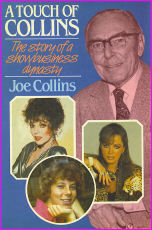
One star I represented did impress Bill (Collins – his son): Dorothy Squires, an ebullient lady with an amazing flow of language. Bill enjoyed visiting Dorothy and her husband, handsome actor Roger Moore. They had a fabulous home in Kent, with a swimming pool (an unusual luxury for Britain in the ‘fifties) and a billiards room. Roger would frequently escape the chitchat of the assembled celebrities at Dorothy’s parties to play snooker with young Bill.
When Dorothy Squires first met Roger, she was a big star with a huge and devoted fan following. As a performer she could ‘sell’ a song better than anyone else, putting enormous emotion into a performance. Even the young Elvis Presley, though their styles were so different, listed Dorothy as his favourite female vocalist. She was clever too, writing many of her own numbers.
At this time Roger, eight years Dorothy’s junior, was just another struggling young actor.
After the couple married – in New Jersey, USA in 1953 – Dorothy confided in me, as her agent, about her ambitions for Roger. She was sure that square jaw, the keen blue eyes, the classic male beauty, would go down well in Hollywood. She encouraged Roger to try his luck there.
In the mid’fifties Roger was given the title role in Ivanhoe, a British television series based on the Walter Scott classic. During the shooting we went to a party at the Moores’ place in Kent. Roger was limping. ‘Got kicked by a horse on location yesterday,’ he explained. ‘The horse obviously shares my opinion of the series.’
Roger was never big-headed or self-obsessed. He felt that his wife Dorothy was more gifted than he was, and he appreciated her support. He was very concerned that I did my best to promote her career and he made sure she got good terms.
When we were not discussing Dorothy’s business affairs Roger and I still found plenty to talk about. He was what used to be called ‘a man’s man’ - a sportsman like me.
The era of lavish parties with Dorothy and Roger ended when Roger went off to Hollywood again for more films and the Alaskans and Maverick television series. However we stayed good friends, even after he parted from Dorothy in 1961. Dorothy went out of my life too. After I had represented her for many years we had an argument and agreed to disagree. My daughters Joan and Jackie, who first met Roger at those parties in Kent, have remained good friends with him.
The
Devil and Miss Jones
From the
autobiography of Janie Jones (pub.1993)
The first charges were connected with the alleged BBC payola scandal (of which I was later found not guilty). Among others arrested at the same time was a leading radio producer, a high ranking man from President Records and the singer Dorothy Squires who recorded for President.
At Bow Street I was put in a cell with Dorothy. It was a horrific and disgusting experience. There was excrement all over the floor and walls. To make matters worse, Dorothy suffered from claustrophobia – she’d never been able to ride in a lift at the record company offices – so she started banging on the door with a shoe. ‘Let us out!’ she shrieked. ‘We’re stars, we’re not criminals, you bastards!’ She was effing and blinding like mad.
‘You silly old bag’ the coppers shouted back, ‘you’re not stars in here, you’re prisoners.’ They were definitely getting their jollies out of it all, seeing Dorothy under pressure and cracking jokes about her age.
I just couldn’t believe what was happening. Three whole years had lapsed since the parties I’d innocently held for President records, and in all that time, I’d never tried to reinstate the separate escort service I’d once provided for rich and titled clients. So I sat calmly in the cell and tried to comfort Dorothy, confident that I’d soon be home for a cup of tea.
Unfortunately, I wouldn’t see my kettle for a very long time.
I was charged and kept in Bow Street overnight. On 19 May 1973 the Daily Mail blared the headline ‘Janie goes to Jail’.
The Biography, by Bernard
Bale and published by Andre Deutsch in 2000, contains a reference
to Dorothy. Bale describes how
Pertwee appeared with Roger Moore in an episode of the TV series Ivanhoe.
When I first met Roger at the studios in his Ivanhoe get-up, I thought that he looked like the prince out of a fairytale. His flawlessly handsome good looks could have been intimidating had he not been such an unaffected young man. He had an absent wife, a singer called Dorothy Squires, years older than him, who lived in Los Angeles. He spoke of her with professional respect and, at the drop of a hat, produced her latest record like other people produce a photograph of their spouse. While Jon was doing his bit in Ivanhoe, we saw a lot of Roger and sometimes he came to stay with us at Bourne End (Pertwee’s converted boat-house in Buckinghamshire).
© 2004 - 2011 www.dorothysquires.co.uk


